List of top 10 features in Java SE 6.
Web Services
You get first-class support for writing XML web service client applications (death of Apache Axis?). No more messing with the plumbing (unless you really want to). You can also expose your APIs as .NET interoperable web services with a simple annotation.
For developers who want to handle XML directly Mustang adds new parsing and XML to Java object-mapping APIs, previously only available in Java EE platform implementations or the Java Web Services Pack.
Scripting
You can now mix in JavaScript technology with your Java technology source code, useful for prototyping. Also useful when you have teams with a variety of skill sets.
Database
The final Mustang development kit will co-bundle the all-Java JDBC database, Java DB based on Apache Derby. This should enable developers (new to Java) to get a jumpstart on java development.
Developers will get the updated JDBC 4.0, which focuses on ease of use. It contains many feature additions like support for XML as an SQL datatype and better integration of Binary Large OBjects (BLOBs) and Character Large OBjects (CLOBs) into the APIs. Additional features that improve ease of use include removal of some JDBC boilerplate and some of the new annotations that make SQL strings embed better into your JDBC application – like decorating your getAllUsers() method with an @Query(sql="select * from user") annotation, and that being all you need. More annotation love for you.
More Desktop APIs
GUI developers get a large number of new tricks to play like the ever popular yet newly incorporated SwingWorker utility to help you with threading in GUI apps, JTable sorting and filtering, and a new facility for quick splash screens to quiet impatient users.
Monitoring and Management
The really big deal here is that you don't need do anything special to the startup to be able to attach on demand with any of the monitoring and management tools in the Java SE platform. Mustang adds yet more diagnostic information, and we co-bundled the infamous memory-heap analysis tool Jhat for forensic explorations of those core dumps.
Compiler Access
Really aimed at people who create tools for Java development and for frameworks like JavaServer Pages (JSP) or Personal Home Page construction kit (PHP) engines that need to generate a bunch of classes on demand, the compiler API opens up programmatic access to javac for in-process compilation of dynamically generated Java code. Finally you don't have to save your code as a Java files and invoke javac to generate a classfile, a clumsy procedure at best.
Pluggable Annotations
Java tool and framework vendors (and you) can define annotations and have core API support for plugging in and executing the processors that do the heavy lifting. It seamlessly integrates your custom annotations .
Desktop Deployment
Better platform look-and-feel in Swing technology, LCD text rendering (more clarity on LCD monitors like Vista), and snappier GUI performance overall. Java applications can integrate better with the native platform with things like new access to the platform's System Tray and Start menu. At long last, Mustang unifies the Java Plug-in technology and Java WebStart engines, which just makes sense. Installation of the Java WebStart application got a much needed makeover.
Security
Mustang simplified the job of security administrators by providing various new ways to access platform-native security services, such as native Public Key Infrastructure (PKI) and cryptographic services on Microsoft Windows for secure authentication and communication, Java Generic Security Services (Java GSS) and Kerberos services for authentication, and access to LDAP servers for authenticating users.
Quality, Compatibility, Stability
Sun has around 80,000 test cases and several million lines of code testing conformance. People have been downloading (and testing) snapshots of Mustang for the last 15 months and filing bugs. So even before beta several quality and regression issues were fixed. Performance is claimed to be better than J2SE 5.
Friday, September 25, 2009

Java Data Types
Arithmetic Demo Click image to read the source code.

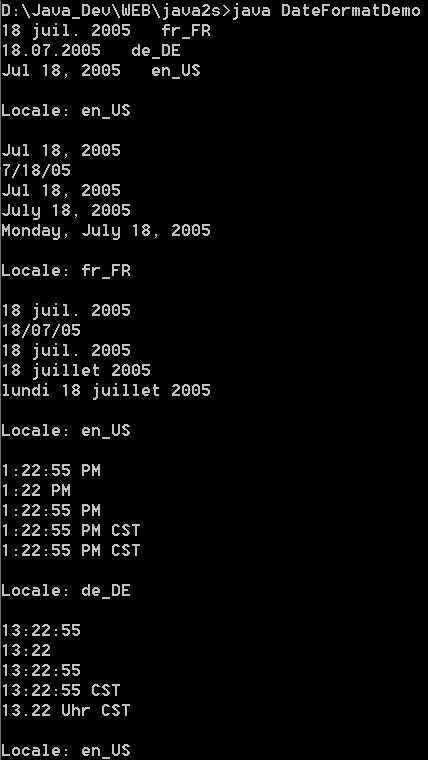
Date Format with Locale Click image to read the source code.

Number Format Test Click image to read the source code.

Relational Demo Click image to read the source code.

Date format: "dd.MM.yy", "yyyy.MM.dd G 'at' hh:mm:ss z","EEE, MMM d, ''yy", "h:mm a", "H:mm", "H:mm:ss:SSS", "K:mm a,z","yyyy.MMMMM.dd GGG hh:mm aaa" Click image to read the source code.

Simple Date Format Demo Click image to read the source code.
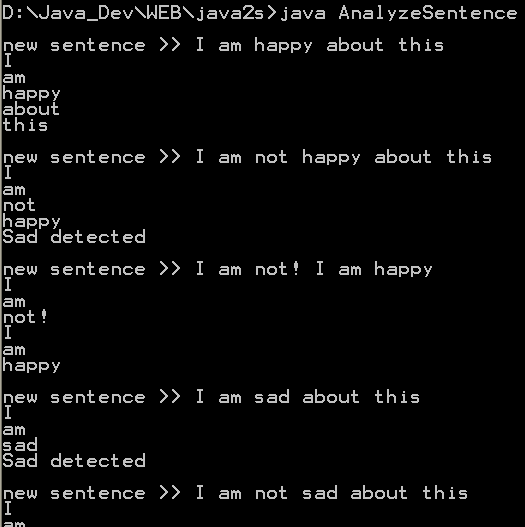
Look for particular sequences in sentences Click image to read the source code.

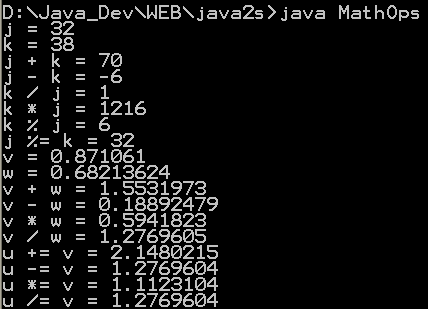
Demonstrates the mathematical operators. Click image to read the source code.



Relational Demo Click image to read the source code.

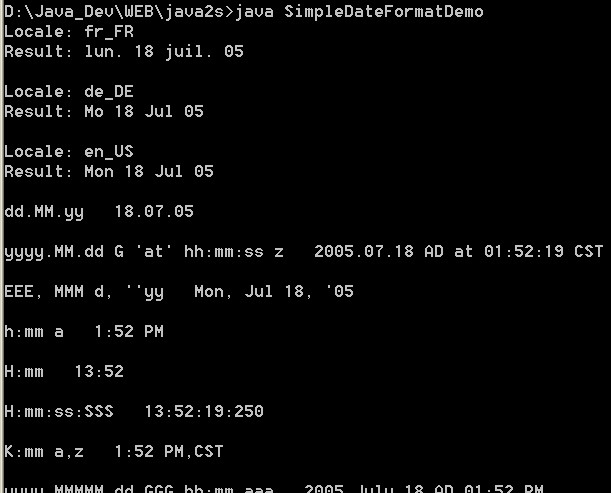
Simple Date Format Demo Click image to read the source code.
Look for particular sequences in sentences Click image to read the source code.
Demonstrates the mathematical operators. Click image to read the source code.
Java
For the past 13 years, Java has changed our world . . . and our expectations..
Today, with technology such a part of our daily lives, we take it for granted that we can be connected and access applications and content anywhere, anytime. Because of Java, we expect digital devices to be smarter, more functional, and way more entertaining.
In the early 90s, extending the power of network computing to the activities of everyday life was a radical vision. In 1991, a small group of Sun engineers called the "Green Team" believed that the next wave in computing was the union of digital consumer devices and computers. Led by James Gosling, the team worked around the clock and created the programming language that would revolutionize our world – Java.
The Green Team demonstrated their new language with an interactive, handheld home-entertainment controller that was originally targeted at the digital cable television industry. Unfortunately, the concept was much too advanced for the them at the time. But it was just right for the Internet, which was just starting to take off. In 1995, the team announced that the Netscape Navigator Internet browser would incorporate Java technology.
Today, Java not only permeates the Internet, but also is the invisible force behind many of the applications and devises that power our day-to-day lives. From mobile phones to handheld devises, games and navigation systems to e-business solutions, Java is everywhere!
Subscribe to:
Posts (Atom)

